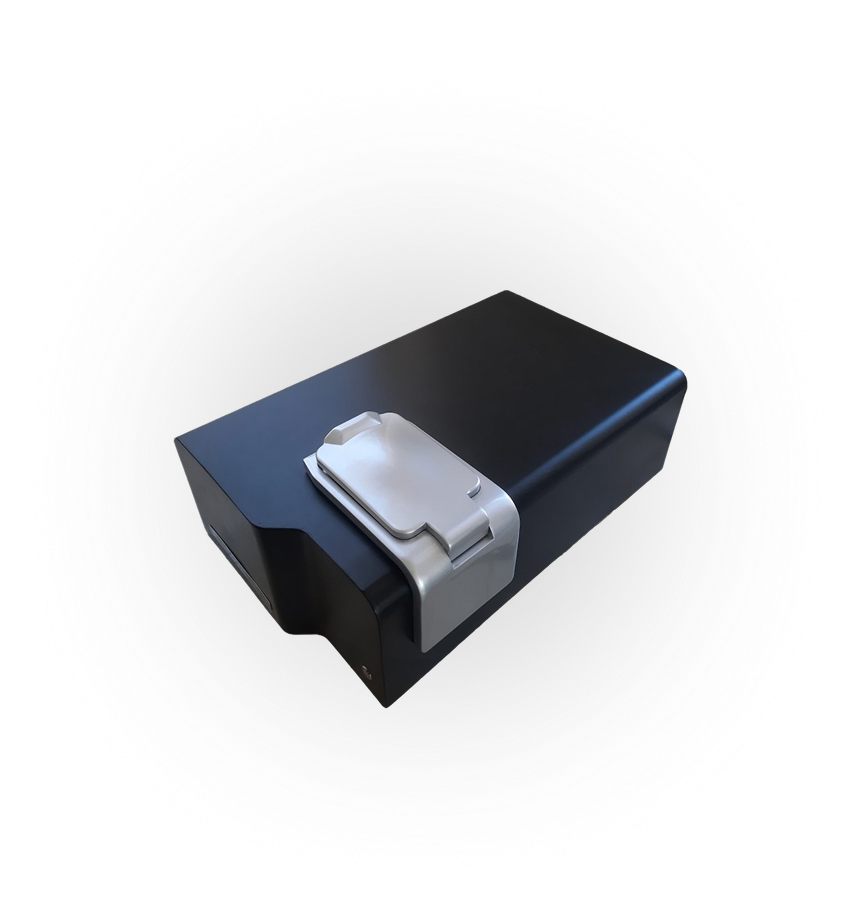
Advanced Particle Analysis System
Engineered for Non-Ideal Samples
Nanosense is an advanced particle analysis system based on Dynamic Light Scattering (DLS), developed to characterize nanoparticle and colloidal systems under conditions where conventional DLS instruments become unreliable. The system is designed to measure particle size distributions in dense, absorbing, heterogeneous, and polydisperse samples, without mandatory dilution or alteration of the sample’s native state.
System Advantages
Why Nanopartizer Differs from Conventional DLS Instruments
The optical configuration minimizes multiple scattering effects, enabling analysis of samples that typically require dilution in standard DLS systems.
Microscopy-based measurement volume
The confined interaction volume improves signal quality and allows localized measurements within heterogeneous samples.
Reduced system cost by design
The detection architecture replaces traditional photomultiplier-based solutions with optimized photodiode detection and external amplification, lowering manufacturing cost while maintaining measurement accuracy.
Integrated statistical and distribution analysis
Particle size is extracted using established DLS methods, including cumulant analysis and numerical inversion techniques.
Nanopartizer Analysis
Software
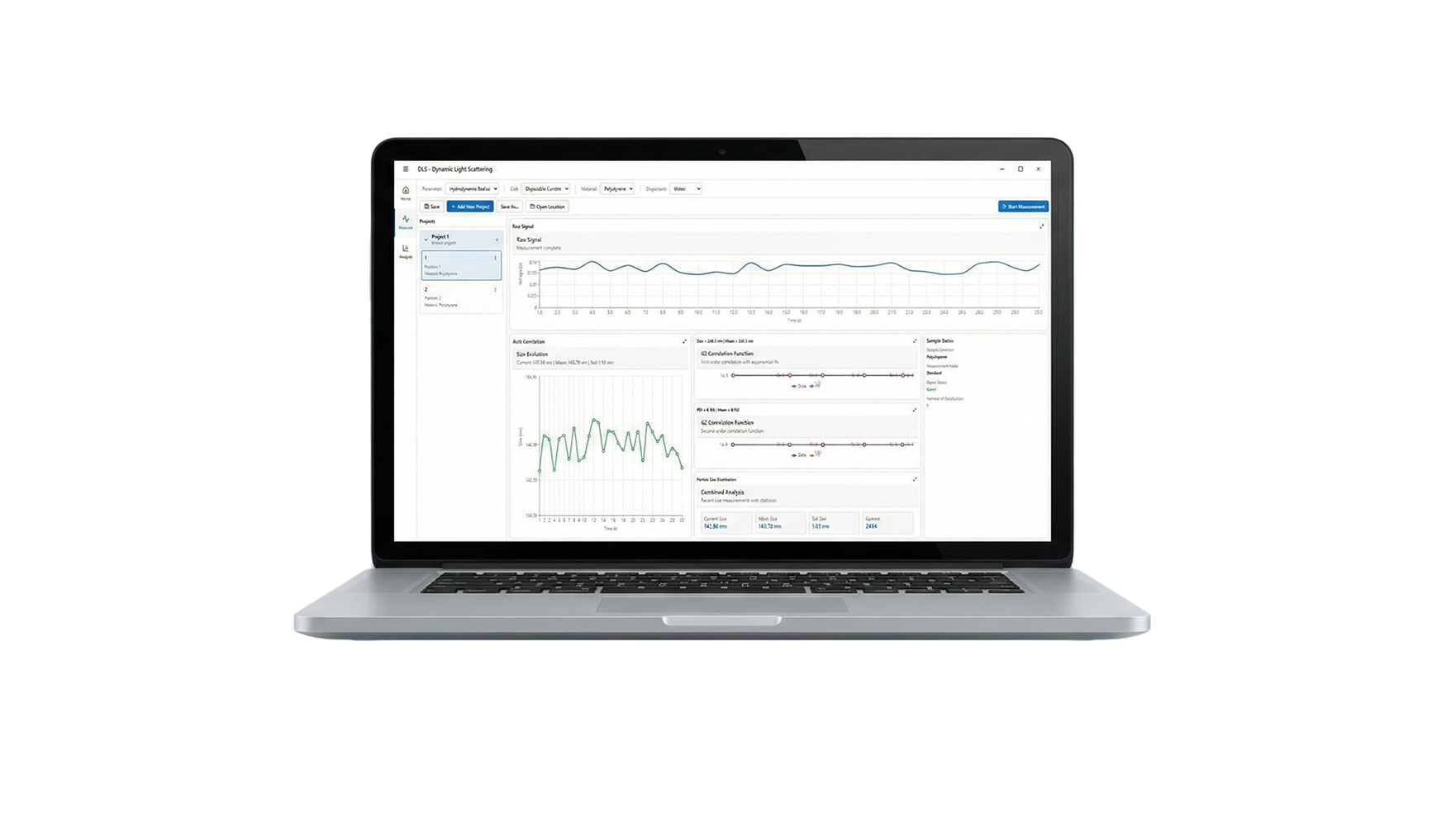
Developed as an independent particle analysis environment, the software can be used with or without the Nanosense hardware system. It is designed to process intensity fluctuation signals originating from laser–sample interactions, regardless of the specific optical or hardware setup used to acquire the data.
As a result, the software can be used to:
• Analyze data from custom-built optical or laser scattering systems
• Re-analyze signals obtained from commercial DLS instruments
• Compare analytical outputs across different measurement setups
• Apply alternative analysis parameters for validation and research purposes
Software Capabilities
Advanced DLS Data Analysis Without Coding
The software processes raw intensity signals and computes particle size information through established and validated DLS methodologies. The user interface requires no programming or scripting, allowing researchers and technicians to perform advanced particle analysis through a guided graphical environment.
Core analytical capabilities include:
Calculation of intensity autocorrelation functions
Cumulants analysis for Z-average size and polydispersity estimation
Numerical inversion of the inverse Laplace transform using CONTIN-based methods
Visualization of particle size distributions and diagnostic plots
Real-time feedback on signal quality and calculation stability